A failed phishing simulation is usually treated as a result: someone clicked, the dashboard logged it, the campaign report moved on.
That is the wrong place to stop.
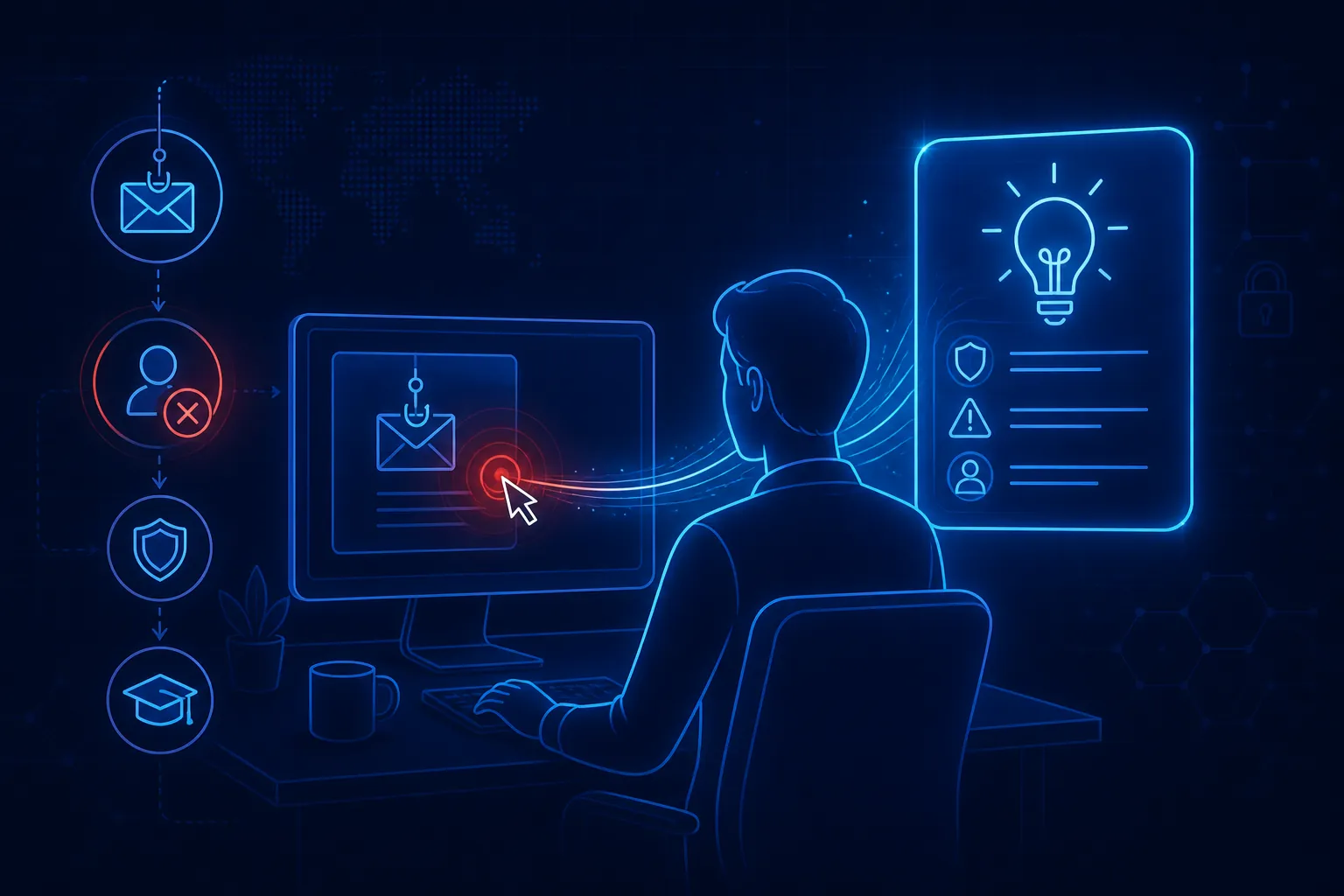
A phishing simulation failure is not the end of the exercise. It is a behavioral signal. It tells you something about what influenced the employee, what they missed, and what should happen next. If the program only records the miss and continues as if nothing changed, it may be measuring behavior without meaningfully changing it.
A Failed Simulation Is Information, Not Just a Score
A click answers one narrow question: did this person engage with this lure? The more useful questions sit underneath that:
- What kind of social engineering worked: urgency, authority, helpfulness, fear of missing out?
- Which warning signs did they miss?
- Was the persuasive part the message, the sender, the page they landed on, or the action they were asked to take?
- Is this a one-off miss, or a pattern for this person or role?
Those details are what make phishing simulation remediation possible. Without them, every failure gets the same generic follow-up, which is almost the same as no follow-up at all.
Do Not Punish the Miss
The worst response to a failed phishing simulation is embarrassment: public call-outs, leaderboards of clickers, or disciplinary pressure dressed up as accountability.
That creates the wrong incentives. People stop reporting suspicious messages because reporting feels risky. They warn colleagues about "the test" instead of treating the next odd request as a real decision. And it misunderstands why social engineering works in the first place. As we have written about human behavior in cybersecurity, these attacks exploit normal attention, trust, and urgency, not character flaws.
A miss should be private, constructive, and useful. Shame is not a training method. We have made that case before in Shame Doesn't Teach, and it applies here as directly as anywhere in security awareness.
The Best Learning Moment Is Right After the Failure
Context decays quickly. The employee still has the lure, the click, and the decision in working memory. That is when a short explanation lands.
A useful response in the moment looks like this:
- Confirm it was a simulated phishing test, without public drama.
- Name the specific tactic that worked.
- Show the safer action they can take next time.
- Keep it brief enough that it reinforces the moment instead of replacing their workday.
That is far more effective than assigning a generic employee phishing training course weeks later, after the details are gone. Immediate, relevant follow-up is the heart of contextual security awareness training: the lesson is tied to what just happened, not to the training calendar.
Match the Follow-Up to the Mistake
Not every failure is the same failure.
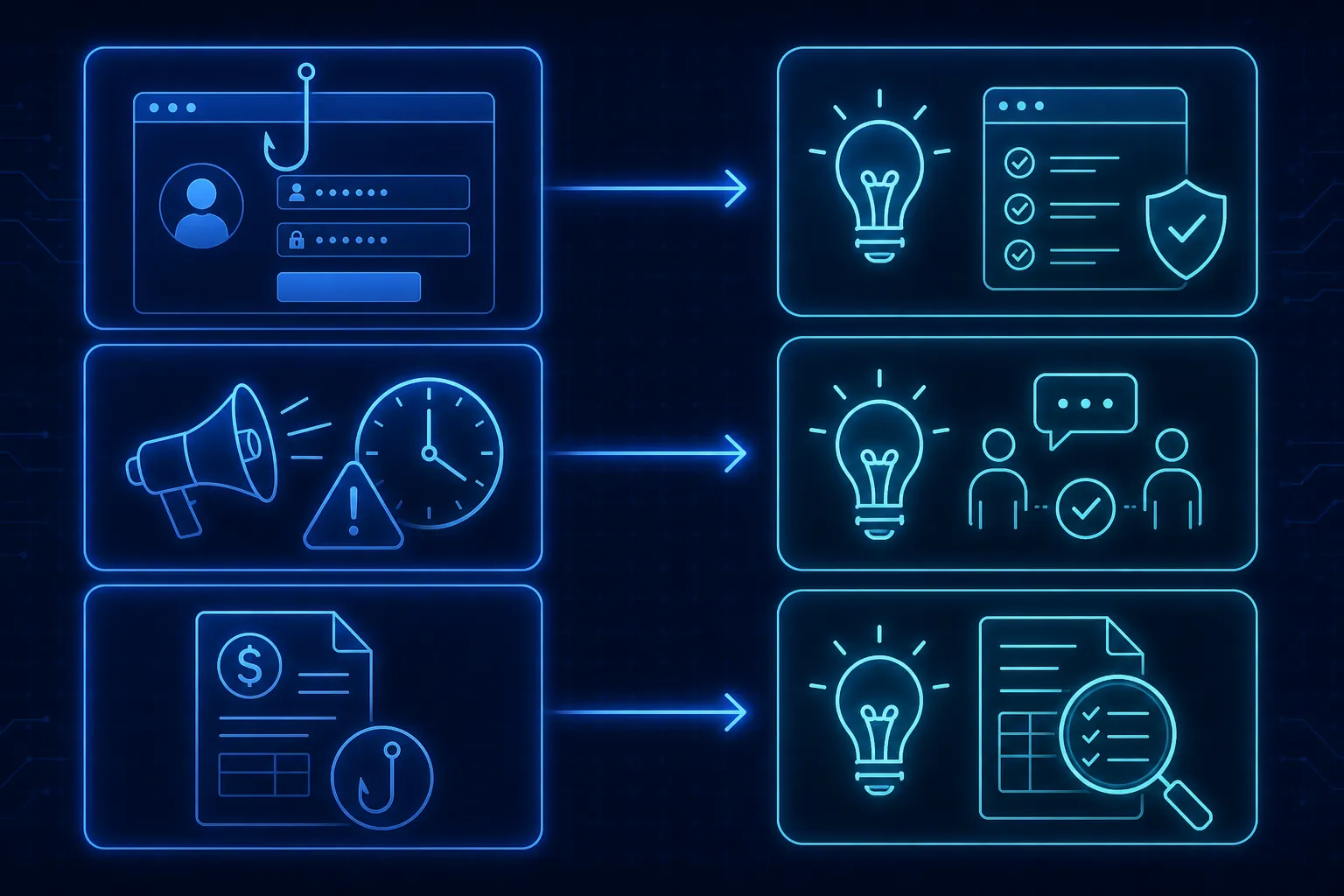
Someone who entered credentials on a fake login page needs different reinforcement than someone who approved an urgent request from a spoofed executive, opened a shared document lure, or paid attention to a convincing invoice change. If remediation ignores those differences, the program is teaching "be more careful" instead of teaching the actual skill that was missing.
The follow-up should map to the miss:
- Fake login or credential harvest: how to verify domains and pause before entering secrets.
- Authority or urgency pressure: how to confirm requests out of band.
- Invoice or vendor fraud: how finance workflows should validate changes.
- Shared document or collaboration lure: how trust in familiar tools gets abused.
When the lesson matches the mistake, phishing simulation training stops being a generic course and starts being practice.
The Next Simulation Should Change Because of This One
If an employee fails a simulation and the next campaign treats them exactly like everyone else, the program is throwing away the signal it just collected.
A failed phishing simulation should influence what comes next:
- Revisit the attack type they struggled with, so you can see whether the lesson stuck.
- Adjust difficulty as they improve, instead of leaving strong reporters on easy templates.
- Vary the scenario enough that people cannot memorize your test pattern.
That is what an adaptive phishing simulation program is for. It is also why phishing simulation frequency alone is not enough. Send the same kind of test often enough and employees get better at recognizing the organization's simulation, not at recognizing real threats. Variation and adaptability matter as much as cadence.
Measure Improvement, Not Just the Click
Click rate answers whether someone failed this particular lure. It does not answer whether the program is working.
Better questions after a phishing simulation failure:
- Does the same kind of mistake repeat for this person?
- Does their reporting improve over time?
- Do they perform better against the attack type they previously missed?
- Do they stay resilient as scenarios get harder?
Those are behavior trends, not campaign snapshots. They are also closer to what human risk management is supposed to measure: whether people are getting harder to fool, not whether this month's template happened to be easy to spot.
Training Is Just Another Layer. Protection Is Still Important
Even a strong learning loop has a limit. Training can improve instincts over time. It cannot make every employee perfect, and it should not be asked to.
While people are still learning, and after they improve, real attacks will keep arriving in the browser, on fake pages, and through social engineering prompts that never look like last quarter's simulation. That is why protection still matters at the point of decision. A miss in a simulation should produce a lesson. A miss in the real world should still have a layer that can interrupt the risky action before credentials are lost. We have written about that surface in phishing protection beyond the inbox.
Training closes gaps over time. Protection covers the gap that is still open today.
The Loop After a Failure
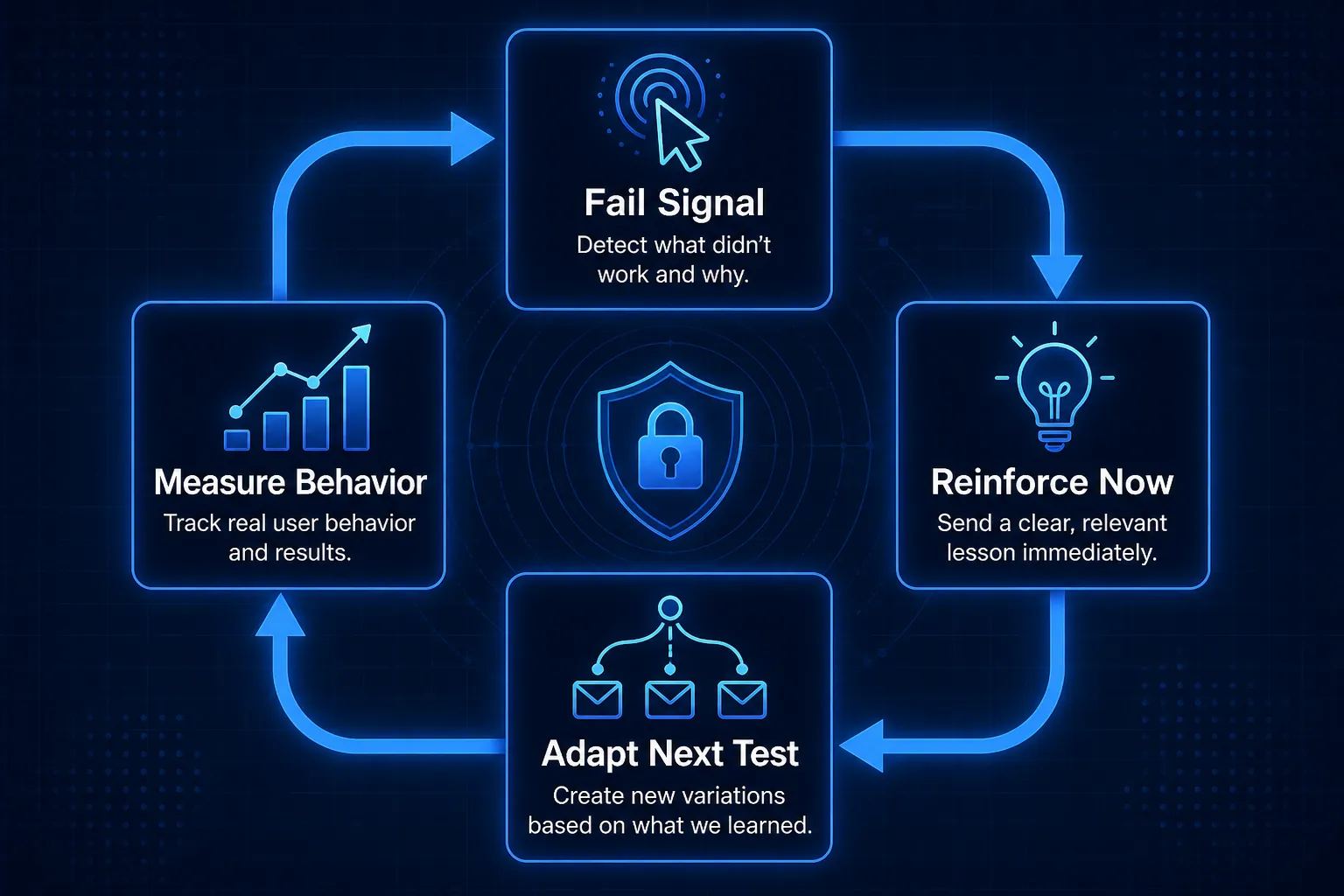
Put together, what should happen after an employee fails a phishing simulation is a loop, not a label:
- Treat the fail as a signal. Capture what worked and what was missed.
- Reinforce immediately. Deliver a short, matching explanation while the context is fresh.
- Adapt the next test. Change difficulty, tactic, or scenario based on that result.
- Measure behavior over time. Watch for repeated misses, better reporting, and improving resilience.
- Repeat. The next simulation is the proof of whether anything changed.
That continuous model is the practical version of the shift described in our Human Risk Defense Playbook: away from isolated awareness exercises and toward programs that use behavior to decide what happens next.
The Bottom Line
A phishing simulation failure should change the program.
If all it changes is a cell in a spreadsheet, the organization learned that someone clicked. It did not necessarily help that person get better, and it did not necessarily reduce risk. The value is in the response: immediate reinforcement, matching remediation, an adapted next simulation, and a clear view of whether behavior improves.
When a failed phishing simulation informs what happens next, the test stops being a score and starts being practice.