
About SavvyShield

We built SavvyShield because training alone is not enough.

Modern attacks reach employees across browsers, email, SaaS tools, and everyday workflows, not just obvious phishing emails. Traditional awareness programs ask users to remember training later. We believe employees need protection at the moment risk appears.

  • Protect first
  • Train in context
  • Adapt continuously
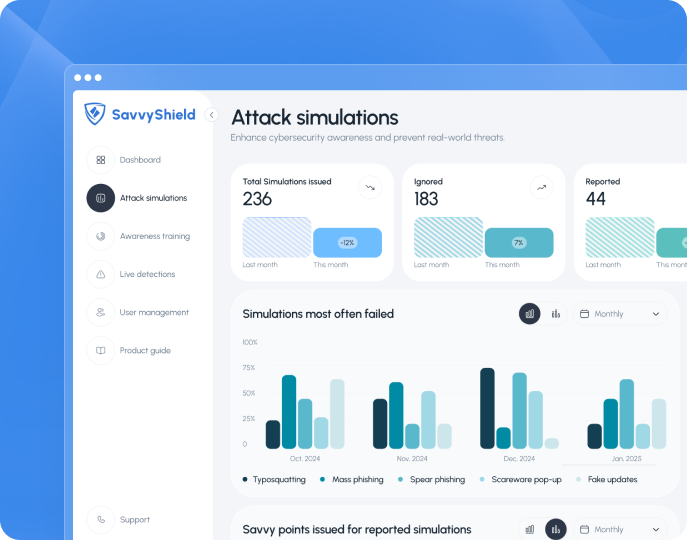
SavvyShield admin dashboard showing attack simulation results

Why we exist

“Employees need help when risk appears, not weeks after a training module.”

Nathan Medeiros

Nathan Medeiros

Founder and CEO, SavvyShield

Security teams have spent years investing in awareness training, phishing tests, and compliance programs. Those efforts matter, but they often happen far away from the moment a real decision is made.

A user does not need help weeks after a training module. They need help when they are about to enter credentials into a suspicious page, click a risky link, respond to a convincing message, or trust a workflow that looks legitimate.

The old model of periodic awareness is no longer enough. Attackers adapt faster than annual content drops can keep up, and employees face risky moments across the tools they use every day, not just in their inbox.

We help organizations move from periodic awareness to continuous human risk defense, built into the places employees actually work.

The shift

From periodic awareness to continuous defense

Human risk changes constantly. Attackers adapt. Employees change roles. New tools appear. AI makes social engineering faster, more personalized, and more convincing. Human risk programs need to adapt just as quickly.

The old modelWith SavvyShield
Training modules people have to remember laterProtection and a short lesson at the moment of risk
Phishing tests on a fixed scheduleAdaptive simulations aimed at each person’s weak spots
Reporting on who finished a videoBehavior-based scoring that shows whether risk is going down
Campaigns, content libraries, and calendars to manageA program that runs itself
Focused on the inboxBrowsers, email, SaaS tools, and everyday workflows

Our approach

One loop that protects, trains, and adapts

  1. ProtectStep in on risky moments in real time.
  2. TrainDeliver a short lesson while the context is clear.
  3. SimulateTest with realistic, relevant threats.
  4. AdaptAdjust to what actually happens.

What makes us different

Not just a phishing simulation platform

SavvyShield combines real-time protection, contextual training, adaptive simulations, and AI-powered risk insights into one human risk defense loop. It helps employees make safer decisions across browsers, email, and everyday workflows, then delivers short, relevant lessons when the context is already clear.

The result is a platform that protects employees while they learn, instead of relying only on users to remember training later.

Built for security teams

Stronger outcomes without the manual overhead

Security teams should not have to manually manage endless campaigns, content libraries, and detached coursework just to keep users engaged. AI helps turn real threats and risky moments into smarter training, more realistic testing, and useful risk visibility, so the program keeps improving over time.

Protect users in real time. Train them in context. Simulate realistic threats. Adapt based on what actually happens.

Our mission

What we hold ourselves to

We want human risk defense to deliver value from day one, stay easy to run, change how people actually behave, and keep pace with the threats organizations face in the AI era.

  • Immediate value while employees learn

    Protection and reinforcement should help employees in the moment, not wait for training to pay off later. Value shows up while people work, not after a campaign ends.

  • Easy to deploy and manage

    Security teams should not need endless manual campaigns, content libraries, or detached coursework to keep a program running. The platform should be practical to roll out and maintain.

  • Actually impact behavior

    Reducing human risk means improving how people respond in real situations, not just tracking completions. Programs should create stronger instincts where decisions actually happen.

  • Readiness for modern threats in the AI era

    Attackers adapt faster, social engineering gets more personalized, and new tools create new risk surfaces. Human risk programs need to keep up with how threats evolve.