Executive Summary
By the Numbers
Around 60% of breaches involve a human element, underscoring why human risk remains one of the most exploited attack surfaces.
The average breach caused by phishing costs USD 4.76 million, showing that phishing remains one of the most financially consequential human-driven attack paths.
Only 34% of organizations run simulated phishing attacks, suggesting that many teams still are not regularly testing real-world user behavior.
Only 7.5% of organizations use adaptive training, indicating that behavior-driven, continuously adjusted awareness programs remain uncommon.
Cybersecurity awareness has long been treated as a necessary layer of defense, but in many organizations, it still operates as a static, compliance-driven program. Annual training, periodic phishing tests, and broad policy reminders may satisfy baseline requirements, but they do not fully prepare users for the speed, realism, and adaptability of today's attacks.
That gap is becoming more dangerous. Modern attackers are using artificial intelligence to generate more convincing messages, impersonate trusted voices, scale personalized outreach, and adapt tactics across multiple channels. Social engineering is no longer limited to suspicious emails with broken grammar or obvious red flags. It now appears in search results, browser prompts, fake login pages, voice messages, collaboration tools, and staged, multi-step attack flows designed to guide users toward a harmful action.
This matters because human risk remains one of the most exploited attack surfaces in cybersecurity. Recent breach research has shown that roughly 60% of breaches continue to involve a human element, a reminder that attackers still find it easier to influence a person than to defeat every technical control around them. Attackers do not always need to defeat hardened infrastructure when they can influence a person to click, trust, download, approve, disclose, or authenticate. In many cases, the user is not the weak link because they lack intelligence or care. They are vulnerable because the attack is well-timed, highly convincing, and embedded in a workflow that feels normal.
As a result, awareness programs must evolve. A modern human risk defense strategy cannot rely on one-size-fits-all training delivered on a fixed schedule. It must continuously assess where users are vulnerable, test behavior in realistic conditions, reinforce safe actions in context, and adapt training based on actual outcomes.
This playbook outlines how security leaders and IT teams can modernize their approach. It explains why traditional awareness models are no longer sufficient, how AI is changing the social engineering landscape, and what organizations can do to build a more adaptive, behavior-driven defense. The goal is not simply to check a compliance box. It is to reduce real-world human risk over time.
The Evolution of Social Engineering in the AI Era
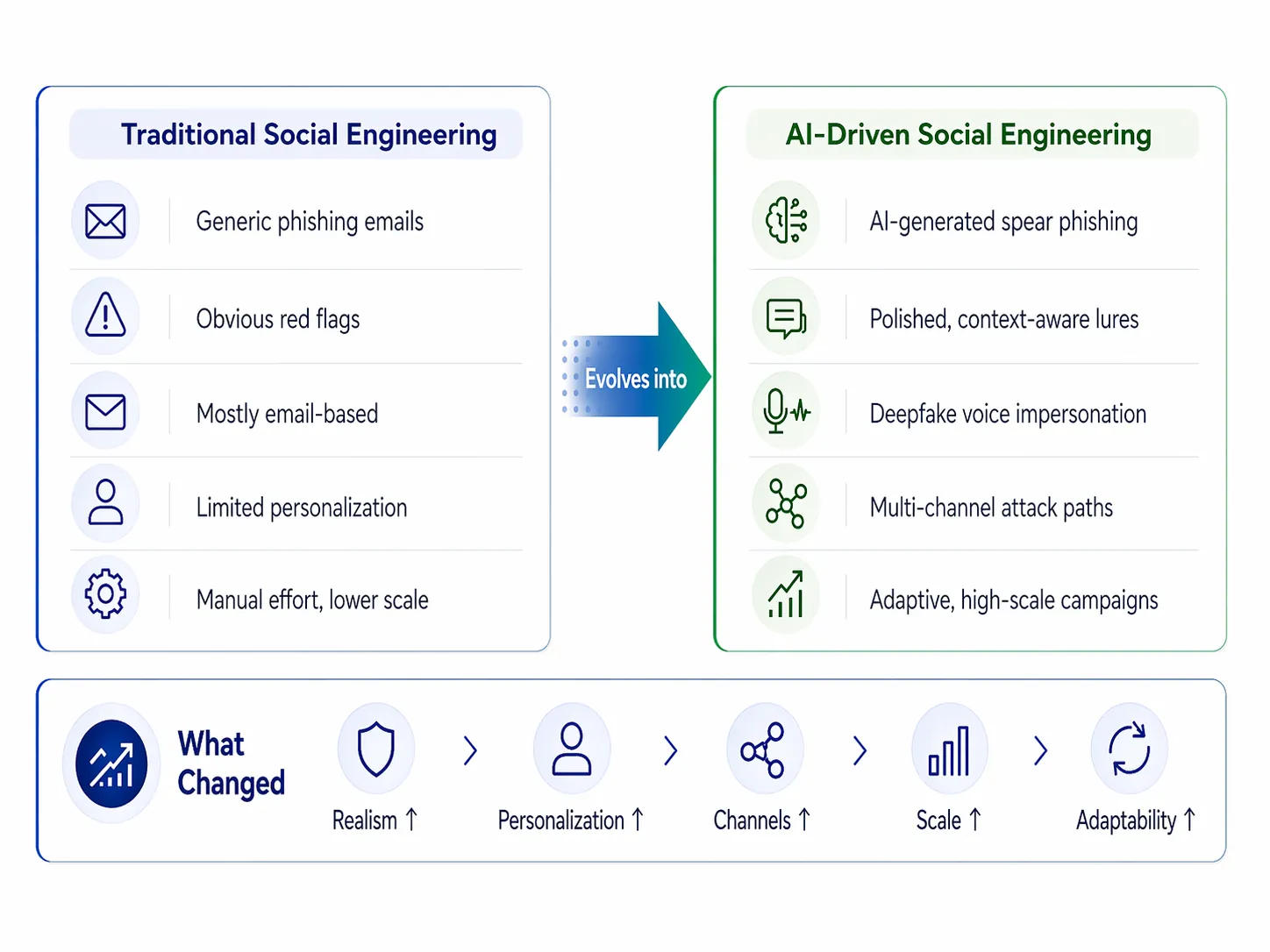
Social engineering has always been effective because it targets trust, urgency, familiarity, and human decision-making. What has changed is the quality, scale, and flexibility with which attackers can execute these tactics.
AI-Generated Phishing and Spear Phishing
Artificial intelligence has lowered the barrier to creating polished, persuasive phishing content. Attackers can now generate messages that are grammatically correct, context-aware, and tailored to specific audiences in seconds. Instead of sending generic phishing emails at scale, they can create variations that reflect a user's role, company language, recent events, or likely responsibilities.
This allows for more believable spear phishing without the same manual effort previously required. A finance employee may receive a payment-related request that mirrors internal terminology. A recruiter may receive a resume-themed lure. An IT administrator may see a message framed around identity verification, security tooling, or cloud access. The quality of these lures continues to improve because AI can quickly refine tone, structure, and realism.
Deepfake and Voice Impersonation Attacks
AI has also expanded social engineering beyond text. Voice cloning and synthetic media enable attackers to impersonate executives, coworkers, vendors, or family members with increasing credibility. A fraudulent voicemail that sounds like a senior leader asking for urgency can pressure employees into bypassing normal controls. A voice call that appears to confirm a fake payment request may be enough to overcome hesitation.
These attacks exploit more than trust. They exploit familiarity. When a voice sounds recognizable, users are more likely to act quickly and less likely to verify independently.
Multi-Step, Cross-Channel Attacks
Today's attacks often unfold across multiple environments rather than within a single email. A user may start with a search engine query, click a malicious ad, land on a fake website, be prompted to install a tool or extension, and then be guided through follow-up steps that appear legitimate. Another user may receive an email, then a text message, then a collaboration-platform notification, each reinforcing the same false narrative.
This progression matters because each step increases credibility. Rather than relying on one message to succeed, the attacker builds momentum and trust over time.
Example Attack Flow
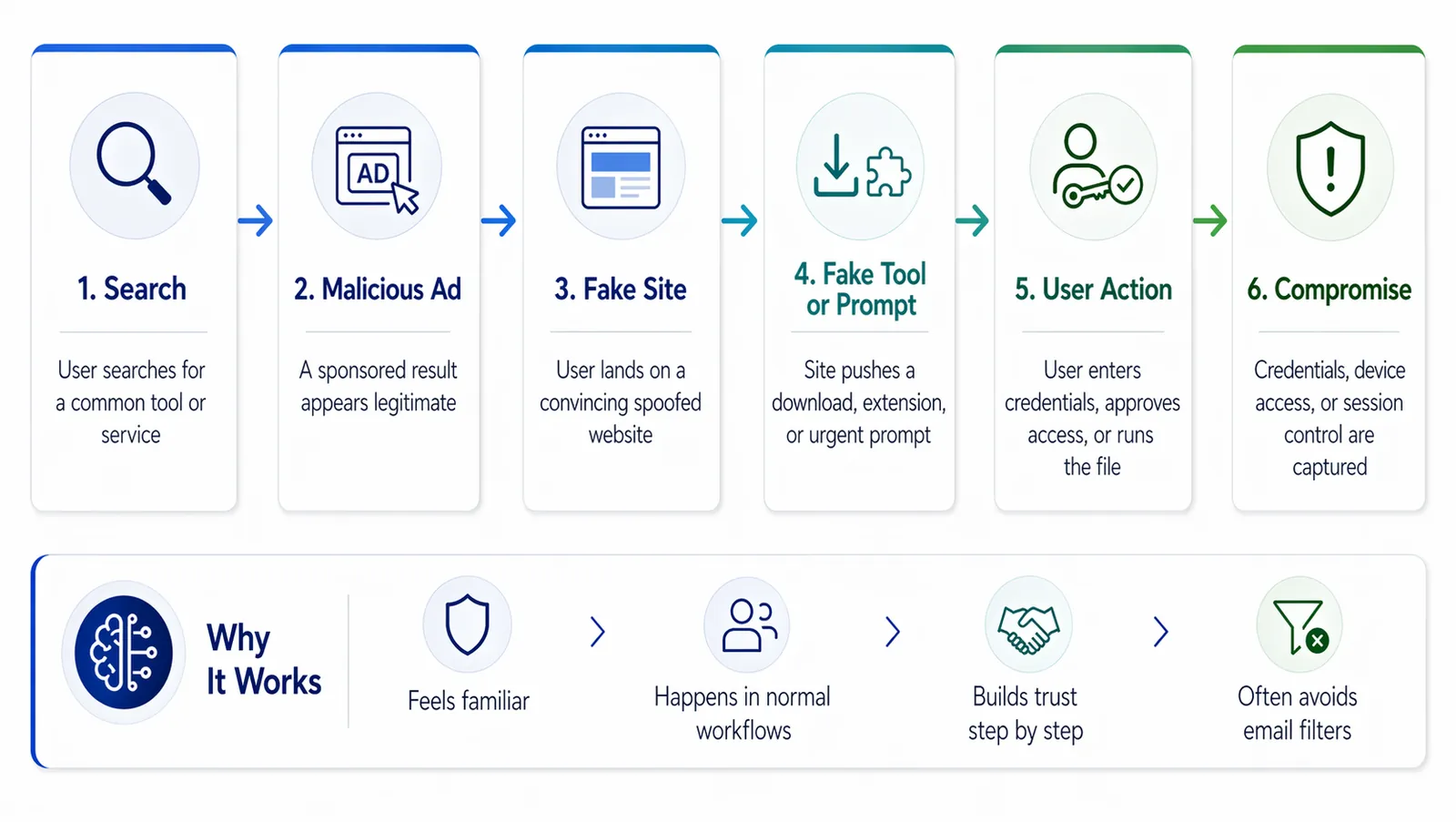
Consider a realistic attack path:
- A user searches for a common business tool or document converter.
- A malicious advertisement appears above legitimate results.
- The user clicks through to a convincing but fraudulent site.
- The site prompts the user to install a browser extension or download a utility.
- The fake tool presents an urgent security message or login requirement.
- The user enters credentials, approves access, or runs a malicious action.
At no point does this attack need to begin in email. It succeeds by blending into common workflows and using trust signals that feel familiar in the moment.
This is the defining shift in the AI era: social engineering is becoming more convincing, more scalable, more personalized, and more embedded in normal user behavior.
Why Traditional Awareness Training Falls Short
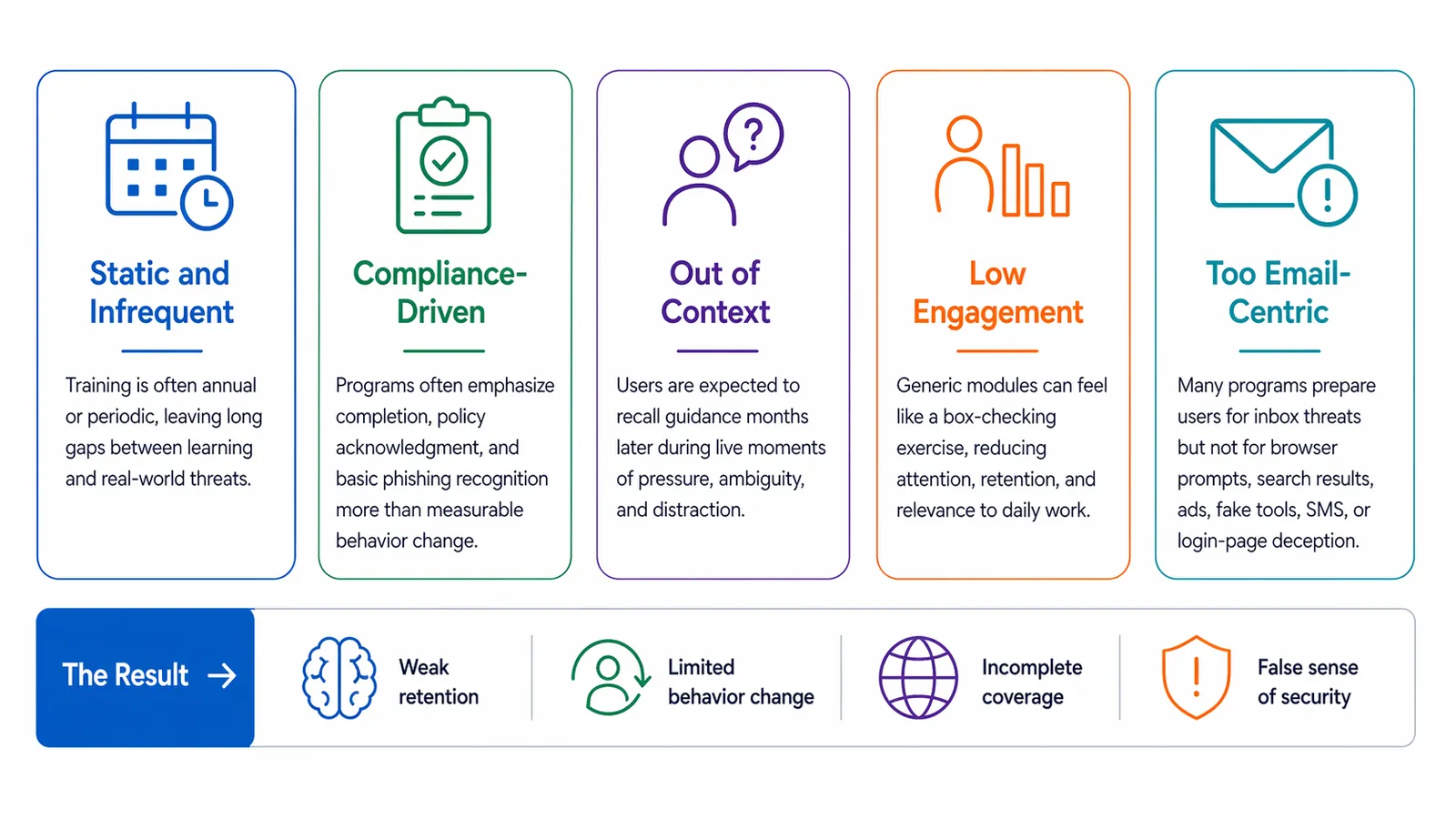
Many awareness programs were built for an earlier threat model. They often emphasize compliance completion, basic phishing recognition, and periodic policy review. While these elements still have value, they are not enough on their own.
Static, Compliance-Driven Training vs. Real-World Behavior
Traditional training is typically delivered on a fixed schedule, often annually or quarterly, with the same material assigned broadly across the organization. Users complete modules, answer knowledge-check questions, and move on. This may demonstrate that training was delivered, but it does not necessarily show that safer behavior has been developed.
Knowing the signs of phishing in a training module is different from recognizing a sophisticated lure while rushing through inbox triage, browsing for a vendor resource, or responding to an urgent prompt in the middle of the workday.
Lack of Context and Timing
One of the biggest weaknesses of static training is that it is disconnected from the moment of risk. Users are expected to remember general guidance from a module they may have completed months ago, then apply it correctly during a live event with real pressure, ambiguity, and distractions.
Learning is more effective when it happens close to the behavior it is meant to influence. If training only occurs far away from the risky decision, retention and application will be limited.
Low Engagement and Retention
Many users view awareness training as a box-checking exercise rather than a meaningful part of their role. That problem is compounded by the reality that many programs still rely heavily on static content and broad assignment models instead of regular behavior-based testing and adaptive reinforcement. In other words, many teams still measure completion more often than they measure behavior.
Generic modules are often too long, too broad, or too disconnected from daily work. As a result, engagement drops, retention suffers, and the program becomes more about completion rates than measurable risk reduction.
Failure to Reflect Real Attack Environments Beyond Email
A major limitation of many legacy programs is their heavy focus on email. Email remains important, but it is no longer the only or even primary path for many forms of social engineering. Users now encounter threats through web searches, ads, browser prompts, collaboration platforms, SMS, fake login pages, software update messages, and fraudulent tools.
When organizations train mostly for inbox-based phishing, they leave users underprepared for the broader environments in which trust is manipulated.
The Core Principle: Human Risk is Not One-Size-Fits-All
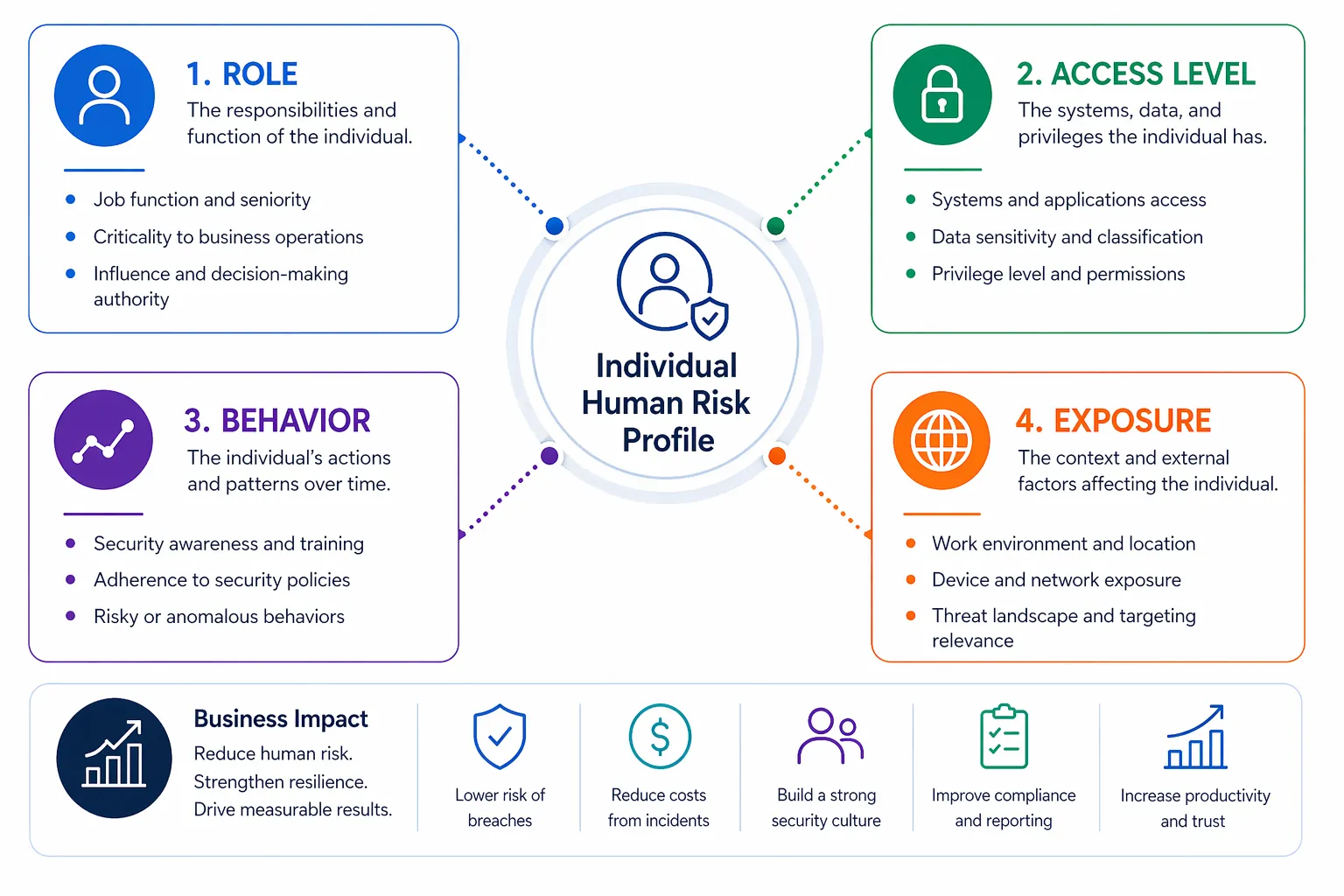
A modern program begins with a simple but important truth: not all users face the same level or type of risk.
Different people interact with different systems, make different decisions, and attract different attack patterns. An executive, a finance manager, a help desk technician, and a marketing coordinator do not all represent the same exposure. Their workflows, privileges, access, and likely adversary approaches vary.
Human risk also varies by behavior. Some users are consistently cautious, report suspicious activity quickly, and pause before acting. Others move quickly, trust familiar-looking prompts, or are more likely to interact before verifying. These patterns matter because they reveal where a program should focus.
Treating all users the same can create a false sense of coverage. Uniform training may appear fair and scalable, but it often misses the areas where targeted intervention is needed most.
An effective program should recognize that:
- Risk differs by role, access level, and departmental function.
- Risk differs by individual behavior and response patterns.
- Risk changes over time based on new threats, user experience, and organizational context.
- Training should be shaped by where users are actually vulnerable, not just by what is easiest to assign broadly.
The goal is not to create unequal standards. It is to apply resources more intelligently so that defenses improve where they matter most.
How to Identify User Weak Points
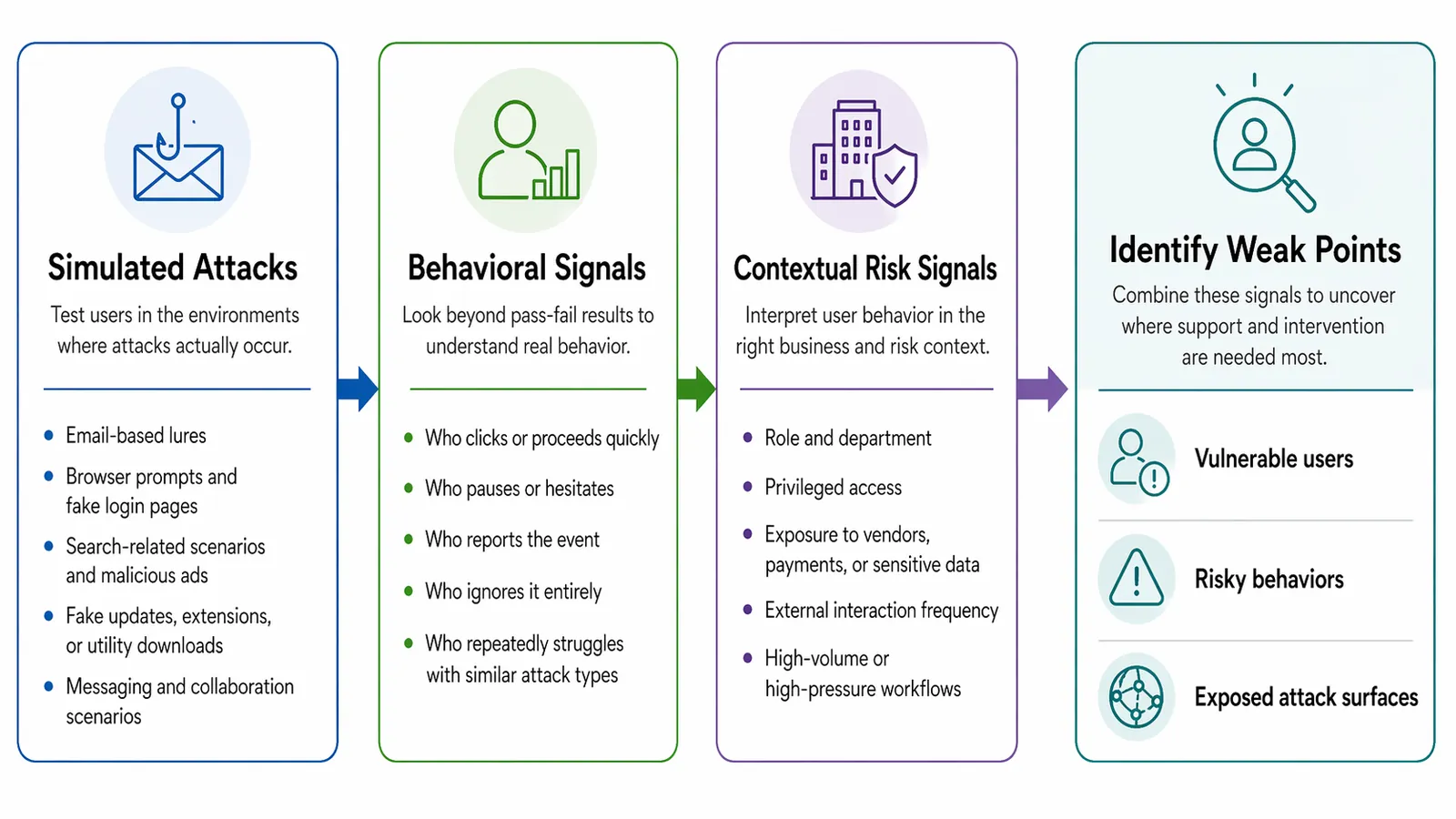
If human risk is dynamic, organizations need reliable ways to uncover where that risk exists.
Simulated Attacks Across Multiple Vectors
Simulations remain one of the most effective ways to evaluate real-world readiness, but they must evolve beyond simple email phishing tests. Organizations should test users across the environments where attacks actually occur, including:
- Email-based lures
- Browser-based prompts and fake login pages
- Search-related scenarios, including malicious ads or typo-squatted domains
- Fake updates, extensions, or utility downloads
- Messaging and collaboration scenarios
These tests help reveal whether users can identify suspicious situations in realistic conditions, not just in abstract knowledge checks.
Behavioral Analysis
Programs should pay attention not only to whether a user fails, but how they behave during a suspicious event. Useful signals include:
- Who clicks or proceeds quickly
- Who pauses or hesitates
- Who reports the event
- Who ignores it entirely
- Who repeatedly struggles with similar attack types
This kind of analysis provides much richer insight than pass-fail counts alone. A user who pauses and reports an event demonstrates a very different risk profile than a user who repeatedly proceeds without verification.
Contextual Risk Signals
Behavior should be interpreted in context. Security teams should account for factors such as:
- Role and department
- Privileged access
- Exposure to vendors, payments, or sensitive data
- Frequency of external interactions
- Remote or hybrid work patterns
- High-volume workflows where speed can override caution
A high-risk user is not necessarily a careless user. Sometimes risk is elevated because the role itself presents more opportunities for exploitation.
Continuous Assessment, Not One-Time Testing
Weak points cannot be identified through a single campaign or annual review. Human risk changes as attackers adapt, users change roles, new tools are introduced, and behavior shifts over time.
That is why assessment should be continuous. Organizations need a living picture of where risk is increasing, where behavior is improving, and where additional support is needed.
Building an Adaptive Human Risk Defense Strategy
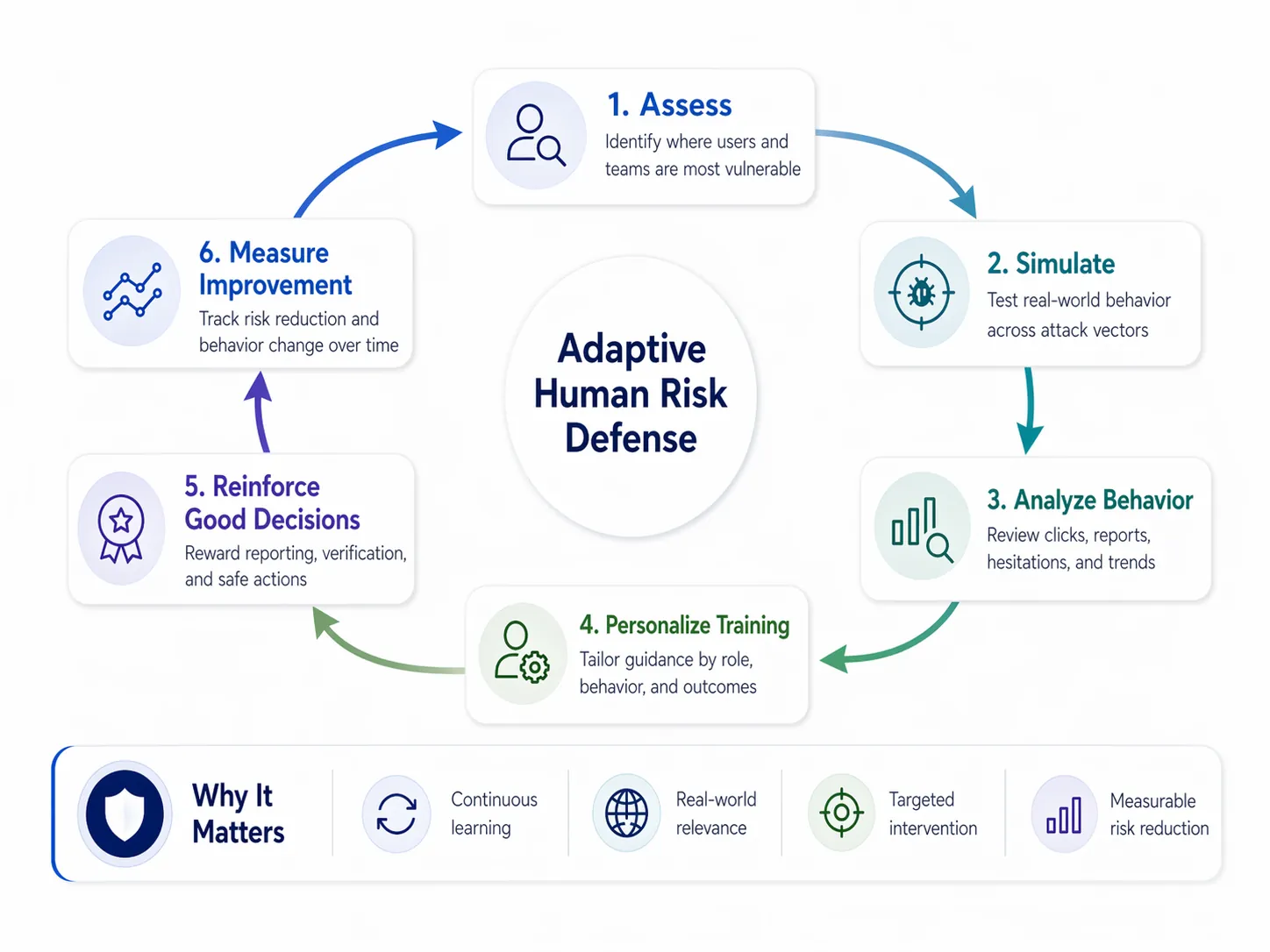
Modern awareness must move from a static training model to a continuous defense strategy centered on behavior, timing, and relevance.
Shift from Static Training to Continuous Learning
Instead of concentrating learning into one or two large annual events, organizations should break awareness into an ongoing process. This can include periodic reinforcement, targeted refreshers, short role-specific modules, and scenario-based learning tied to current threat patterns.
Continuous learning keeps security awareness active rather than episodic.
Deliver Training in the Moment of Risk
Training is often most effective when it appears immediately after a risky action or during a realistic scenario. When users receive feedback close to the decision point, the lesson is more memorable and more likely to influence future behavior.
For example, if a user interacts with a suspicious prompt, the follow-up learning should explain what made the scenario risky, what signals were missed, and what the safer action would have been. This turns a failure into a concrete learning opportunity rather than a generic reminder.
Personalize Training Based on Behavior and Outcomes
Users should not all receive the same content at the same frequency. Someone who struggles with fake login pages may need targeted reinforcement around verification and credential safety. Someone in finance may need more focused training on approval fraud, vendor impersonation, or payment-related social engineering.
Personalization makes training more relevant and more credible. It also respects user time by focusing attention where it will have the most impact.
Reinforce Positive Behavior, Not Just Failures
Many programs focus heavily on mistakes. While it is important to address failures, strong programs also reinforce what users are doing right. When users report suspicious events, pause before acting, or follow verification steps correctly, those behaviors should be recognized and encouraged.
Positive reinforcement helps build a culture in which secure behavior is visible, repeatable, and valued.
Expanding Beyond the Inbox
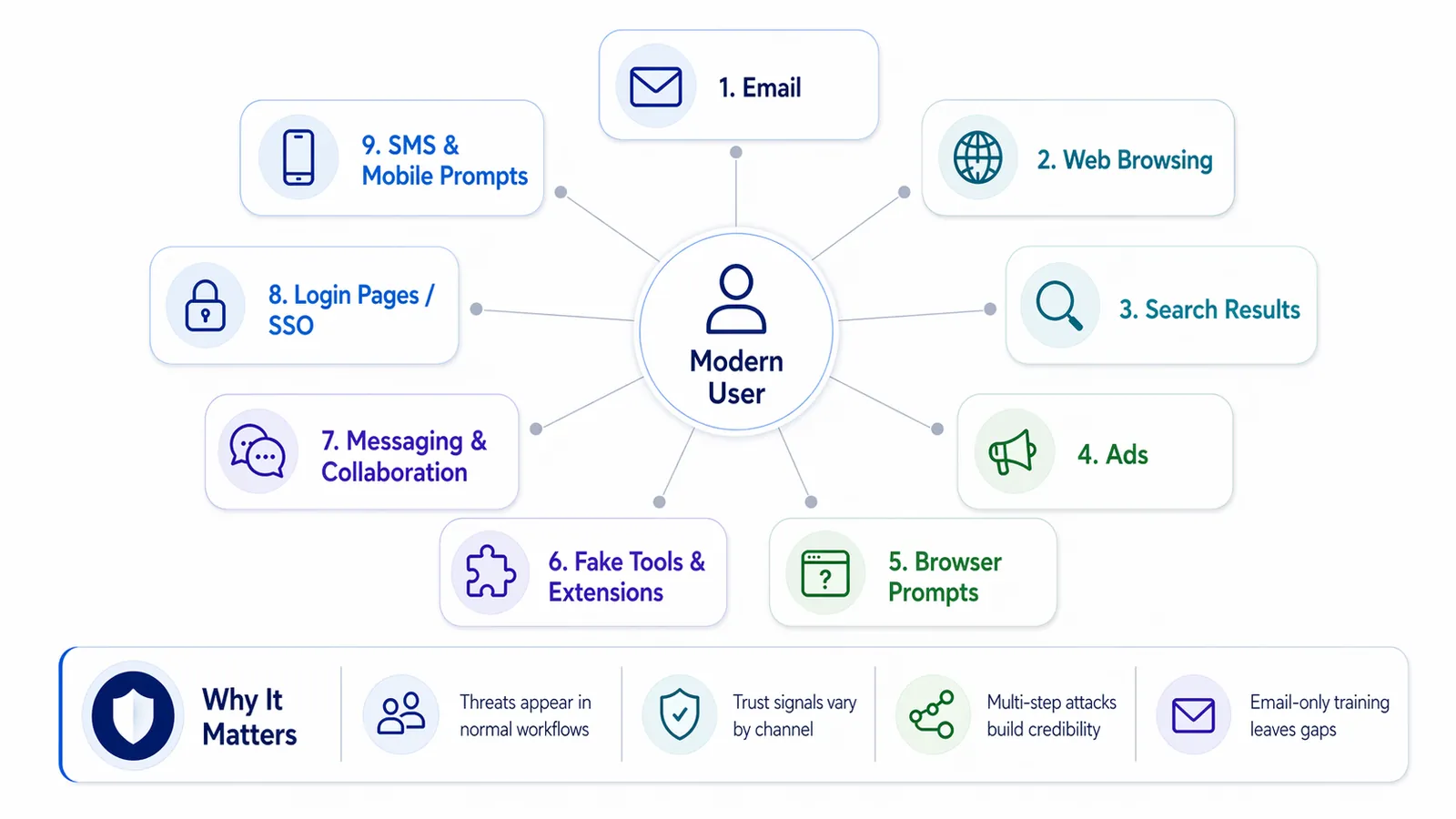
One of the clearest priorities for modern programs is to move beyond email-centric awareness.
Web Browsing Threats
Users routinely make trust decisions while browsing. Threats in this environment include:
- Malicious websites posing as legitimate services
- Fake software updates
- Deceptive download prompts
- Typosquatted domains that resemble real brands or tools
- Fraudulent login pages designed to harvest credentials
These experiences often appear in moments when users are trying to complete ordinary work quickly. That makes them especially dangerous.
Search Results and Ads
Users often trust search engines to guide them to legitimate resources. Attackers take advantage of this by purchasing ads, manipulating search visibility, or creating lookalike destinations designed to intercept users before they reach the real site.
An employee searching for a payroll portal, document-sharing tool, remote support utility, or browser extension may not realize that the first result is malicious.
Fake Tools, Extensions, and Prompts
Another growing risk area involves deceptive utilities and browser interactions. Users may be asked to install a browser extension, update a plugin, fix an error, enable access, or follow a series of prompts that seem technical and routine. These flows are powerful because they exploit user trust in productivity and troubleshooting processes.
Why Email-Only Focus Leaves Major Gaps
If awareness programs primarily teach users to inspect sender addresses and hover over links in emails, they are only covering part of the real attack surface. Social engineering now appears across the full digital workflow. A program that ignores browser, search, prompt, and tool-based threats leaves users exposed in environments they interact with every day.
Testing Real-World Behavior, Not Just Knowledge
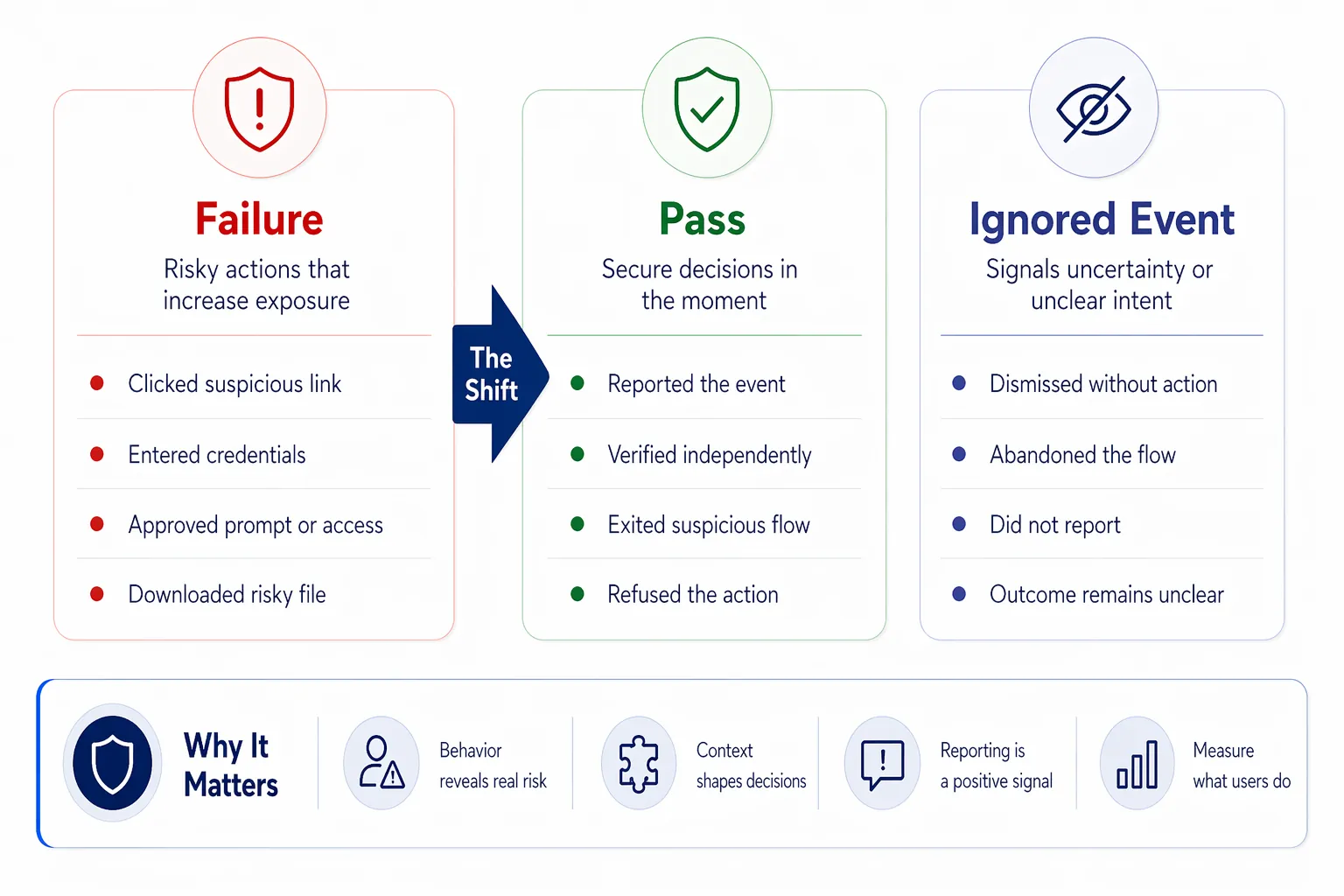
Security teams should measure how users behave in context, not just what they can recall in theory.
The Importance of Realistic Simulations
Effective simulations mirror the ambiguity and realism of live threats. They should feel plausible, role-relevant, and embedded in normal workflows. This does not mean tricking users unfairly. It means creating learning opportunities that reflect the kinds of decisions attackers try to exploit.
A realistic simulation might involve a fake sign-in prompt after a search result, a deceptive browser message, or a vendor-style communication tailored to a department's routine activity. The purpose is to observe behavior under conditions that resemble the real world.
Testing Decision-Making in Context
What matters most is not whether users can recite policy language. It is whether they pause, verify, report, or proceed when presented with a believable situation.
Testing decision-making in context helps organizations understand the gap between knowledge and action. That gap is where much of human risk lives.
Measuring Outcomes
A mature program should track multiple outcomes, including:
- Failures: The user takes a risky action, such as clicking through, entering credentials, approving a prompt, or downloading a suspicious file.
- Passes: The user handles the situation correctly by avoiding the risky action, verifying independently, or reporting the event.
- Ignored events: The user dismisses or abandons the event without clearly passing or failing.
Each of these outcomes reveals something useful. Failures identify intervention needs. Passes show effective behavior. Ignored events can indicate uncertainty, missed awareness, or scenarios that require closer interpretation.
Measuring and Improving Human Risk Over Time
Awareness maturity is not defined by completion rates alone. It is defined by whether measurable human risk is decreasing.
That shift matters financially as well as operationally. IBM reports that the average breach caused by phishing costs USD 4.76 million, which makes phishing not only a common entry point but also a costly one. That underscores why reducing human-driven exposure is not just a training concern, but a business resilience priority.
Key Metrics to Track
Organizations should monitor metrics such as:
- Risk trends across users, teams, and departments
- Repeat failure patterns by attack type
- Reporting behavior and verification actions
- Training engagement and completion quality
- Improvement over time following targeted reinforcement
- Differences between high-risk and lower-risk user groups
These metrics help security teams move from intuition to evidence.
Using Insights to Refine Strategy
Measurement should feed action. If one department shows repeated failures around browser-based threats, that area may need more focused simulations and training. If executives are frequently targeted with impersonation-style lures, the program should account for that risk explicitly. If users improve significantly after short, timely interventions, the organization has evidence that the approach is working.
The goal is a feedback loop that matches the adaptive cycle shown in Building an Adaptive Human Risk Defense Strategy.
Those steps map to the following in practice:
- Assess: Identify where users and teams are most vulnerable.
- Simulate: Test real-world behavior across attack vectors.
- Analyze behavior: Review clicks, reports, hesitations, and trends.
- Personalize training: Tailor guidance by role, behavior, and outcomes.
- Reinforce good decisions: Reward reporting, verification, and safe actions.
- Measure improvement: Track risk reduction and behavior change over time.
This cycle allows the organization to continuously refine its human defense posture instead of relying on assumptions.
Quick Wins: Immediate Actions to Strengthen Human Defense
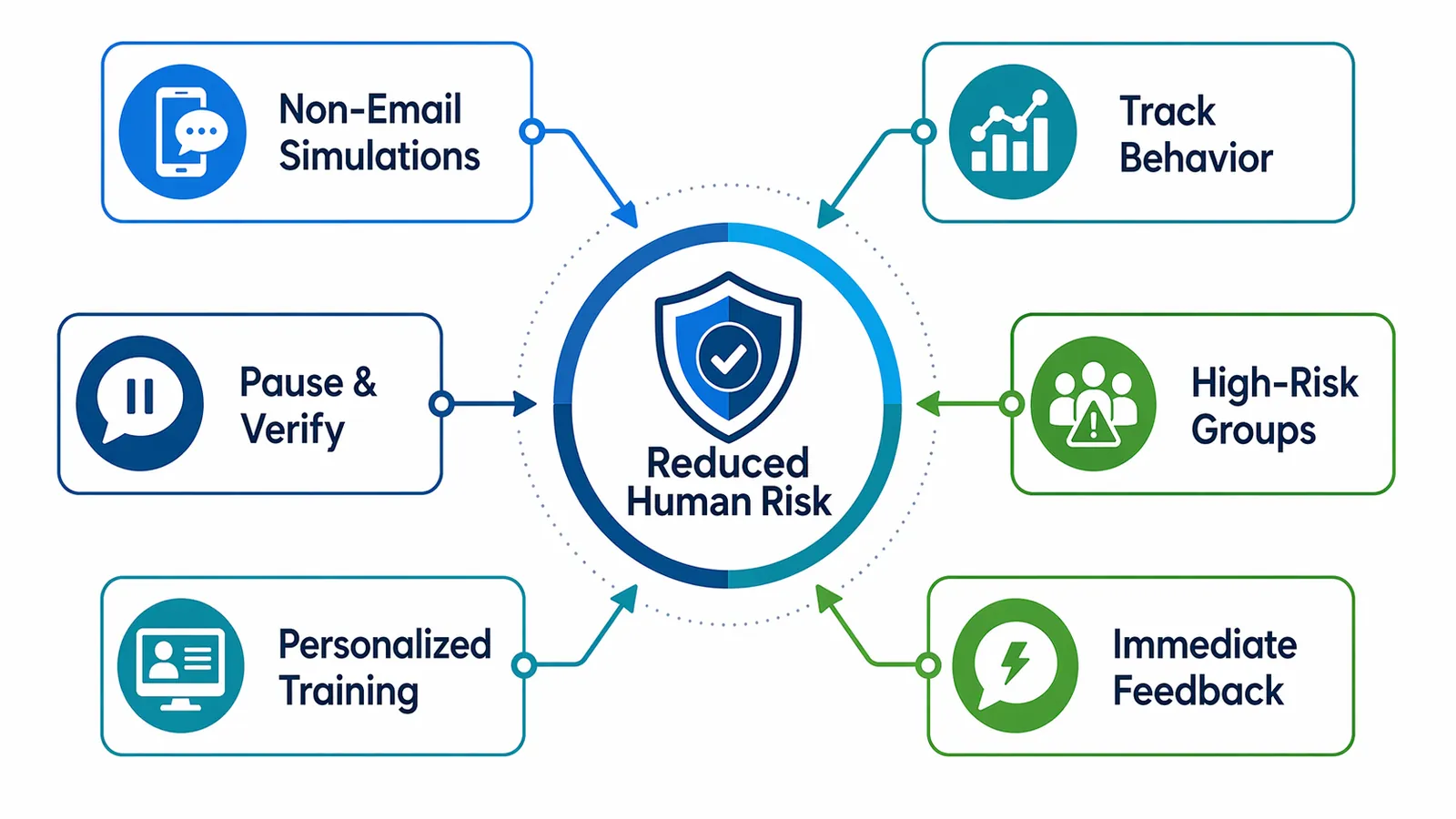
Organizations do not need to rebuild their entire program overnight. Several practical actions can improve readiness quickly.
1. Introduce Simulations Beyond Email
Expand testing to include browser prompts, fake login pages, malicious search scenarios, and deceptive download flows. This helps align awareness efforts with how modern attacks actually occur.
2. Start Tracking Behavior, Not Just Completion
Measure who reports, who hesitates, who fails, and who repeatedly struggles with the same attack types. Behavioral data is far more useful than completion records alone.
3. Reinforce a "Pause and Verify" Culture
Promote a simple, repeatable habit: pause before acting, verify through a trusted path, then proceed. This is one of the most practical defenses against urgent or highly convincing social engineering.
4. Identify High-Risk User Groups
Look for users or departments with elevated exposure, sensitive access, or repeated failure patterns. Prioritize them for more targeted testing and reinforcement.
5. Shorten and Personalize Training Content
Replace long, generic modules where possible with shorter, role-relevant lessons tied to actual behaviors and scenarios users encounter.
6. Add Timely Follow-Up After Risky Events
When a user fails a simulation or interacts unsafely, provide immediate feedback that explains what happened and how to respond more safely next time.
7. Review Coverage Across Attack Environments
Map where your current program focuses and where it does not. If most of your awareness efforts still center on email, identify the browser, search, messaging, and prompt-based gaps that need attention.
Future Outlook: Preparing for What's Next
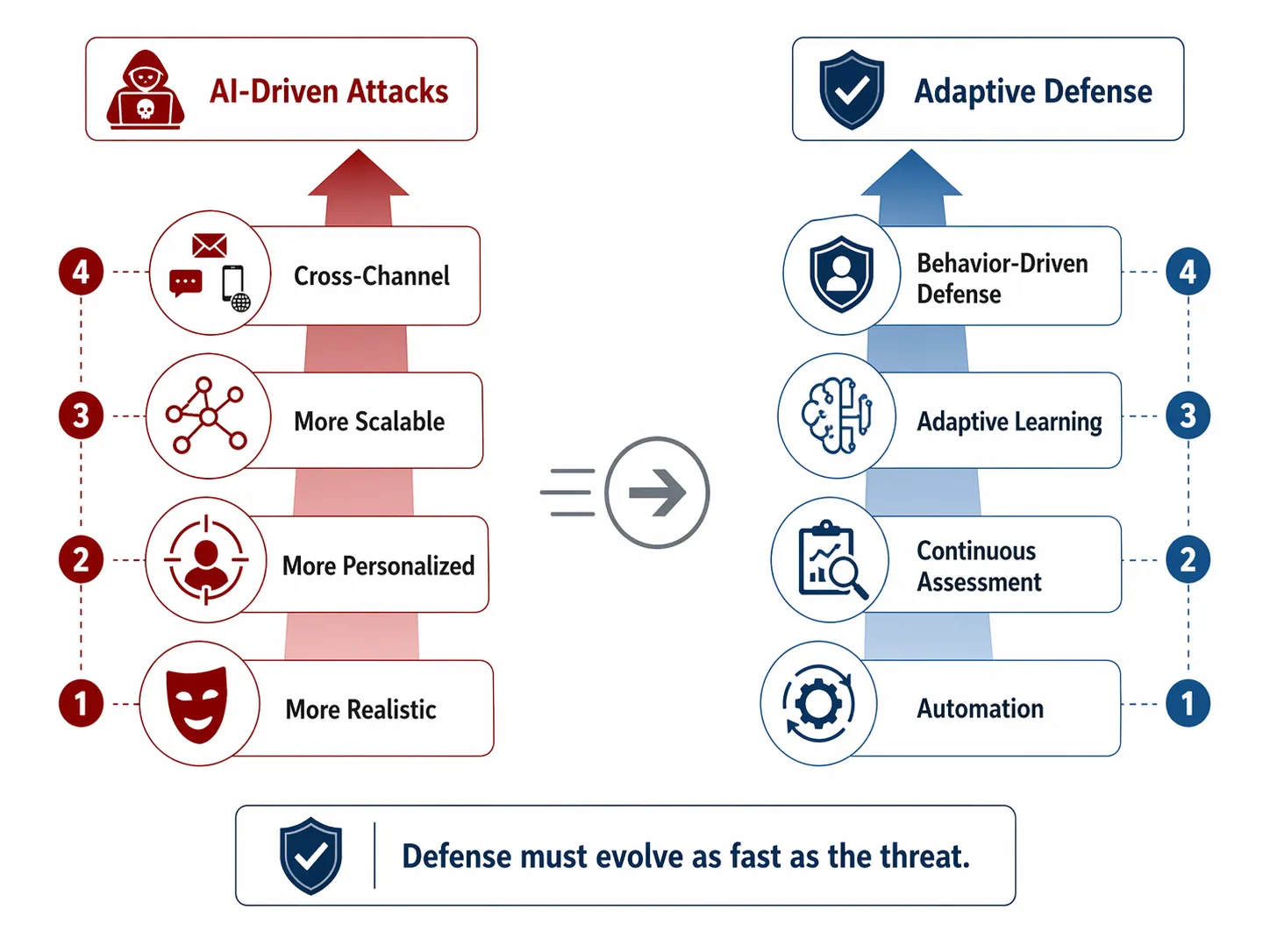
AI-driven attacks will continue to become more polished, targeted, and scalable. Attackers will improve their ability to mimic trusted communication, create realistic pretexts, adapt to defenses, and exploit new digital environments where users make fast decisions.
Organizations should expect more:
- High-quality impersonation attempts
- Cross-channel attack coordination
- Personalized lures based on public and organizational context
- Faster iteration of attack themes and narratives
- More deceptive browser and workflow-level social engineering
In response, human risk defense must become more adaptive as well. Manual, infrequent, and generic programs will struggle to keep pace. Security teams will increasingly need automation to help identify patterns, deliver timely reinforcement, and scale behavioral assessment without overwhelming internal resources.
The future of awareness is not a yearly training event. It is a continuous capability that learns, adjusts, and responds as both users and threats evolve.
Conclusion
Human risk remains one of the primary attack surfaces in modern cybersecurity because attackers continue to exploit trust, urgency, familiarity, and routine behavior. When roughly 60% of breaches still involve a human element, and when the average breach caused by phishing costs USD 4.76 million, the case for modernizing awareness is no longer theoretical. It is operational and financial. In the AI-driven threat landscape, these attacks are becoming more convincing, more scalable, and more difficult to recognize through traditional awareness methods alone.
That is why static, one-size-fits-all training is no longer enough. Organizations need a more modern approach to human risk management, one that reflects how attacks actually happen, identifies where users are vulnerable, and improves behavior through continuous assessment and adaptive learning.
The strongest programs will move beyond compliance-only thinking and toward a practical model of behavior-driven defense. They will test users in realistic conditions, deliver training when it matters most, personalize interventions based on actual outcomes, and measure progress over time.
The objective is not perfection. It is steady risk reduction.
Organizations that modernize their approach now will be better prepared not only for current threats, but for the next generation of social engineering tactics still emerging.
Sources / References
- IBM. Phishing and Spear Phishing. Referenced for the estimated average cost of a breach caused by phishing.
- IBM. Cost of a Data Breach Report 2024. Referenced for broader breach cost context and business impact framing.
- Verizon. 2024 Data Breach Investigations Report (DBIR). Referenced for the share of breaches involving a human element.
- FBI Internet Crime Complaint Center (IC3). 2024 Internet Crime Report. Referenced for the financial impact of Business Email Compromise and phishing-adjacent fraud trends.
- Public reporting and threat research on AI-enabled social engineering, deepfake impersonation, and cross-channel attack techniques. Referenced for the threat evolution and example attack-flow discussion.